
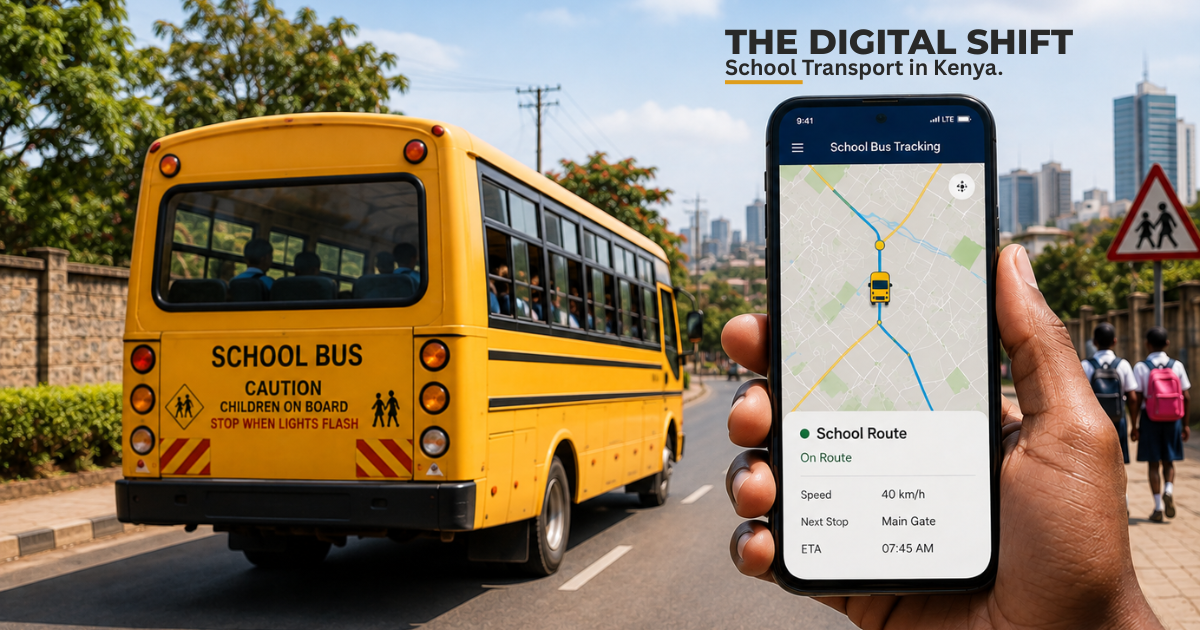
School transport in Kenya has been under the spotlight for most of 2026, with new regulations, Senate hearings, enforcement campaigns, and a steady stream of road safety warnings from the National Transport and Safety Authority (NTSA). Amid all the back-and-forth over what the law requires, one thing has become clear: the direction of travel is digital. Schools that get ahead of it will be better placed than those waiting for a mandate to force their hand.
The Changing Landscape of School Transport in Kenya
The push for digital oversight of school transport didn’t come out of nowhere. It followed a string of serious accidents involving learners and PSVs and a broader national conversation about road safety that has played out in headlines all year. In January, NTSA reaffirmed the 6am–6pm operating window for school buses, with the restrictions intended to limit school transport operations during higher-risk hours.
By April 2026, ahead of the second-term reopening, NTSA had issued an 8-point safety checklist and begun mandatory roadworthiness checks on school buses and vans under its “Watoto Wafike Salama” (Let Children Reach Safely) campaign, with a focus on brakes, tyres, lights, and functioning seatbelts.
Then came the big move: the Traffic (School Transport) Rules, 2026, which required school transport vehicles to have telematic systems for monitoring vehicle operations, alongside reflectorised stop-arm signals to protect children boarding and alighting. It was the most ambitious digital safety mandate the sector had seen.
That mandate didn’t survive. Private schools warned the Senate that the new rules, including inspections, telematics, and stop-arms all at once, would be too costly to implement and could push transport fees higher for families. In July, the Senate annulled the rules entirely, sending NTSA back to the drawing board.
Why “Digital” Still Matters: Rules or No Rules
It would be easy to read the annulment as a sign that digital transport monitoring is off the table. It isn’t; it’s simply no longer mandatory. The underlying safety problem the rules we’re trying to address haven’t gone anywhere. Kenya’s roads remain dangerous, and NTSA continues to intensify oversight of school transport during key travel periods. NTSA’s holiday-season enforcement operations and ongoing safety campaigns make it clear that scrutiny of school transport is not letting up, regulations or not.
That’s exactly why individual schools shouldn’t wait for a law to tell them what’s already sensible.
practice. Here’s what digital tools actually offer, independent of any regulatory requirement:
- Real-time visibility. Knowing exactly where a bus is at any moment — not just trusting that it’s “on its way” — changes the entire safety conversation for parents and administrators alike.
- Accountability for drivers. Speed, route adherence, and harsh braking can all be monitored, turning “the driver said everything was fine” into something schools can actually verify.
- Faster response to incidents. If a bus breaks down, deviates from its route, or is delayed, a digital system flags it immediately instead of leaving parents in the dark until pickup time comes and goes.
- Parent trust and communication. Automated pickup and drop-off notifications reduce the anxious phone calls to the school office and build confidence that safety isn’t just a policy on paper.
- A stronger position for future regulatory changes. Given the direction of Kenya’s transport policy, schools should continue monitoring future developments around digital monitoring and vehicle safety. Schools that establish good digital transport practices now may find it easier to adapt to future requirements.
Addressing the Real Concern: Cost
The debate surrounding the regulations highlighted legitimate concerns about affordability, implementation, and the cost of compliance. But there’s a meaningful difference between a blanket government mandate forcing every school to comply on the same timeline and a school choosing a digital transport solution that fits its own fleet size and budget. Schools adopting tools voluntarily can:
- Start with a pilot on one or two routes before scaling fleet-wide.
- Choose tracking solutions priced for smaller operations rather than enterprise-grade systems built for large PSV fleets.
- Spread the investment over a term or a school year rather than facing a single compliance deadline.
Approached this way, digital adoption becomes a manageable operational upgrade rather than a costly compliance exercise, which is precisely the distinction that got lost when the 2026 rules tried to impose it all at once.
What Schools Can Do Today
- Audit your current transport oversight. If the honest answer to “Where is the bus right now?” is “We’d have to call the driver.” That’s the gap worth closing first.
- Talk to parents about what they actually want. Ask parents which transport information would give them the most confidence, such as real-time tracking or pickup and drop-off notifications, before investing in a solution.
- Start small and scale. A pilot on your highest-risk or longest route can prove the value of digital tracking before a full rollout.
- Keep an eye on NTSA’s next regulatory move. The annulled rules will likely return in a revised form. Schools that already have digital habits in place will find compliance a formality rather than a scramble.
The Way Forward
Kenya’s school transport sector spent 2026 balancing safety ambitions with the realities of implementation and cost. The regulations may have been annulled, but the need for better visibility, accountability, and communication has not disappeared. The safety pressures that prompted the original rules haven’t disappeared, and the role of technology in improving school transport visibility remains relevant. Schools that treat digital transport tools as a genuine safety investment, not just a box to tick for regulators, will be the ones best prepared for whatever Kenya’s transport future holds.