
Excerpt: Discover the responsibilities of a school bus attendant, why clear expectations matter, and how schools can improve student supervision, communication, and transport accountability.
A school bus attendant does more than help students board and leave a vehicle. Depending on the school’s procedures, the role may involve checking who boards, supporting student supervision, reporting incidents, and communicating information the transport team needs to act on.
The difficulty arises when these responsibilities are assumed rather than clearly assigned. Who confirms that the expected students have boarded? Who reports a discrepancy? Who follows up when information from the bus and the school office does not match?
These may seem like small administrative questions, but they affect how consistently a school can account for students throughout a transport journey. Defining the attendant’s role is one step towards ensuring that important responsibilities do not fall between people.
What Is the Role of a School Bus Attendant?
A school bus attendant travels with the driver to support students during the journey. Depending on the school or operator, the same role may be described as a bus attendant, conductor, or escort. Although these terms can be used differently across organisations, the underlying purpose is to support students and help the journey run according to the school’s procedures.
The attendant’s responsibilities differ from the driver’s, although the two roles work together. The driver primarily focuses on operating the vehicle safely, following the assigned route, and responding to issues on the road. The attendant’s role focuses on student supervision, boarding and drop-off procedures, and communicating issues that require attention.
For example, the driver may need to concentrate on navigating a busy junction while the attendant helps maintain order among students. If a student expected at a stop does not board, the attendant may need to report the discrepancy so the appropriate person can investigate.
Neither role operates in isolation. The school or transport operator needs to establish how the driver, attendant, and transport team share information and what each person is expected to do when something does not go as planned.
Core Responsibilities of a Bus Attendant
The precise duties of an attendant depend on the school’s arrangements, the students being transported, and the procedures in place. However, several responsibilities are worth defining clearly.
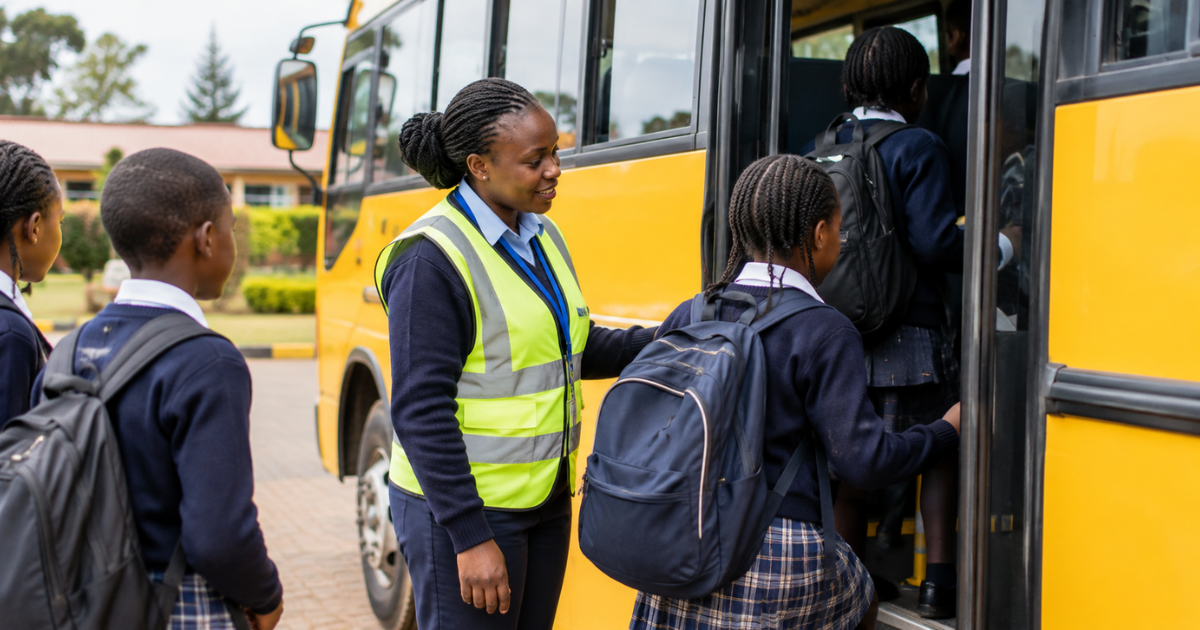
Supporting boarding and drop-off. The attendant helps students board and leave the vehicle according to the school’s procedures. This may include checking that students have boarded the appropriate bus, helping younger children settle, and following established arrangements for drop-off and handover. The attendant should know what to do when a student is collected by someone other than the usual person or when an unexpected change occurs.
Checking which students are travelling. Schools need a reliable way to establish which students are expected on a route and which have actually boarded. Depending on the school’s process, the attendant may help verify student attendance and report discrepancies. A headcount can be useful, but it may not identify which student is absent or whether someone has boarded the wrong vehicle. Clear checking procedures help the attendant recognise when further action is needed.
Supporting students who need additional assistance. Some students may need extra support because of their age, disability, medical needs, or anxiety about travelling. Where relevant information has been appropriately shared, the attendant should understand the support arrangements that apply during the journey and know when to seek assistance. The school should also make clear which responsibilities fall within the attendant’s role and which require support from a designated staff member.
Reporting incidents and unexpected changes. Delays, breakdowns, injuries, behavioural concerns, and discrepancies in student attendance may require prompt communication. The attendant should know whom to contact, what information to provide, and which situations require immediate escalation. A consistent reporting process makes it easier for the transport team to understand what happened and decide what needs to happen next.
Supporting order and communication. The attendant can help maintain an orderly environment, address student behaviour within the scope of the role, and communicate relevant concerns to the driver or transport team. This allows issues to be addressed without assuming that the driver can monitor every aspect of the journey while operating the vehicle.
These responsibilities become more manageable when attendants understand what is expected, have the information they need, and know where their responsibilities end and someone else’s begin.

A bus attendant helps students board in an orderly way.
Where Unclear Responsibilities Create Gaps
The challenge is not necessarily that attendants do not understand their work. It is that a responsibility may be understood differently by the attendant, driver, and school office.
Consider a student who boards the bus but remains marked as absent in the school’s records. The attendant assumes the office has updated the information, while the office assumes the bus team has confirmed the student’s presence. Until someone checks, the two records tell different stories.
The problem is not simply the incorrect record. It is the absence of a clear process for confirming boarding, reporting discrepancies, and ensuring they are resolved.
Similar gaps can occur when staff members change. A new attendant may inherit a route without knowing which students need additional support, how absences are reported, or whom to contact when a planned pickup changes. Procedures that previously depended on one person’s memory may become inconsistent when that person leaves.
Schools can reduce this uncertainty by documenting responsibilities and making essential procedures accessible to the people who need them. This is also relevant to the wider challenge of how schools avoid transport chaos when staff change.
Clear responsibilities do not eliminate every mistake. They make it easier to identify who needs to act, communicate relevant information, and follow up when something goes wrong.
What Schools Can Do to Define the Role More Clearly
Schools do not need to redesign their entire transport operation to improve how the attendant’s role is managed. They can start with four practical steps.
- Define responsibilities at each stage of the journey.
A job description should do more than state that the attendant supervises students. It should explain the tasks expected before departure, during boarding, while travelling, at drop-off, and at the end of the route.
For each task, the school should clarify who is responsible, what information is needed, and what the attendant should do if the expected procedure cannot be followed. This gives attendants a clearer reference point and helps transport managers identify gaps in the process.
-
Establish clear reporting and escalation procedures.
Attendants should know whom to contact when a student is missing from the expected passenger list, a stop is missed, a delay occurs, or an incident requires attention.
The school should also establish who receives the report, who investigates the issue, and who communicates with parents when necessary. Sending a message is only one part of the process; someone must be responsible for following up.
-
Provide training that reflects the role.
Training should cover the school’s actual transport procedures, student supervision expectations, relevant safeguarding practices, and emergency arrangements. Where first aid or other specialised duties are required, the school should ensure that staff receive appropriate training and understand the limits of their responsibilities.
New attendants should also be familiarised with the routes, reporting contacts, and systems they are expected to use. The Bunifu Go Bus Assistant/Agent User Guide can serve as a reference for the app’s relevant functions when training staff to use the platform.
-
Review whether procedures are being followed.
Defining a responsibility is only the beginning. Transport managers also need a way to review whether procedures are working as intended.
For example, recurring discrepancies between expected and recorded boarding, repeated reporting delays, or unresolved incidents may indicate that a procedure needs attention. Reviewing these patterns helps schools identify where additional training, clearer instructions, or changes to the process may be necessary.
The aim is not to create paperwork for its own sake. It is to make responsibilities easier to understand, follow, and review.
Where Transport Records Help
Attendants’ observations are more useful when relevant information is recorded consistently and shared with the appropriate people. Records can help schools review what was reported, identify recurring issues, and follow up on discrepancies rather than relying entirely on memory or informal conversations.

Attendants and staff can use shared records to check which students have boarded and follow up on discrepancies.
Boarding records are one example. Where a school uses a system that records a student’s boarding, the information can support the school’s attendance-checking process. It is important, however, to distinguish between a student being recorded as boarding and having verified information about every subsequent stage of the journey.
A boarding record does not, on its own, establish that a student remained on the vehicle, reached the intended destination, or was handed over to the correct person. Those outcomes depend on the school’s procedures and the information its systems actually capture.
For a closer look at this distinction, read School Bus Tracking and Student Boarding Verification: Closing the Visibility Gap.
The wider principle is that records should support clearly defined responsibilities. Technology can make certain information easier to capture and review, but schools still need procedures that explain how staff should respond to the information they receive.
Defining the Role Is the First Step
A bus attendant plays an important part in supporting students throughout the school transport journey. But the value of the role depends not only on the tasks an attendant performs but also on whether those tasks are clearly defined, properly supported, and connected to the school’s wider transport procedures.
For school leaders, a useful starting point is to review what attendants are expected to do at each stage of a route. Check whether reporting lines are clear, whether staff know how to handle discrepancies, and whether the school can review the information needed to follow up on issues.
Where gaps exist, clearer procedures and consistent records can help make the operation more accountable.
Schools looking to improve visibility into their transport operations can explore Bunifu Go’s features to see how the platform supports the recording and review of transport information. Those ready to explore implementation can get started here.