Imagine a driver has been late to the same stop three mornings this week. Nobody flagged it. Nobody connected the pattern. The first time an administrator hears about it is when a parent calls to complain, by which point it’s not just a pattern anymore; it’s a trust problem.
In many schools, conversations about driver performance happen after something has already gone wrong. A parent complains about harsh braking. A bus arrives late repeatedly. A driver takes an unexpected route. The issue gets investigated, a phone call is made, and everyone moves on.
But what if the school could see those patterns before the complaint arrived?
Driver performance data changes the order of events. Instead of finding out about a problem from a parent, an administrator can use available journey and driving information to identify patterns that may need attention. That shift, from reactive to visible, is what can make a transport operation more proactive, not simply a longer list of features on a vendor’s website.
Here’s what driver performance data can actually change for the people running the operation, not just the people driving it.
1. It Turns “Something Feels Off” Into Something You Can Act On
Every transport office can have a version of this: a vague sense that one route or one driver is a recurring source of complaints, without enough information to understand why.
Without useful data, addressing the issue may mean relying on memory, informal notes, or one person’s account of what happened.
Performance data, such as speeding events, harsh-braking incidents, route adherence, or on-time consistency, can turn that vague concern into something more specific. Instead of saying, “Parents have been complaining about your route,” an administrator can investigate the underlying information and have a more informed conversation about what is happening. One is a feeling; the other gives everyone something concrete to examine.
And that distinction matters. A driver may be responsible for a recurring issue, but the data may also reveal that the problem is connected to a particular road, stop, traffic pattern, or scheduling issue.
When evaluating a system, look beyond individual incidents. Ask whether it helps you identify patterns over time. A dashboard that shows one speeding event in isolation is a log. A system that helps you understand recurring patterns is a management tool.
2. It Makes Coaching Possible Instead of Just Discipline
In many schools, conversations about driving performance happen after a complaint or incident. By then, the administrator is responding to a problem rather than preventing one.
Ongoing performance information can support a different approach. A recurring pattern, consistently hard braking, repeated speeding alerts, or regular delays on a particular route, can give an administrator a reason to investigate and coach before the issue becomes more serious.
That doesn’t mean every alert should result in disciplinary action. The goal shouldn’t be to turn every journey into a disciplinary scorecard. Good performance data should give administrators context for better conversations.
A recurring pattern may point to a coaching opportunity. A consistently strong record can reinforce good driving practices. And if a complaint turns out to be unfounded, reliable records can give both the school and driver a clearer picture of what actually happened. The technology is most useful when it supports safer, more accountable driving, rather than simply creating another layer of surveillance.
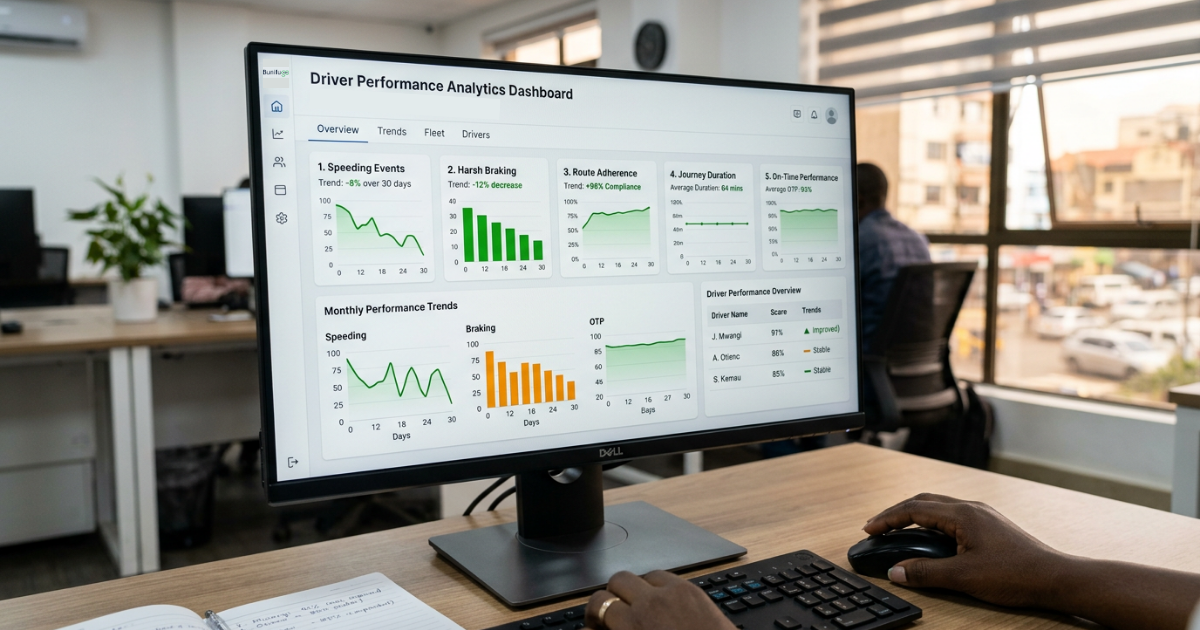
The Bunifu Go dashboard gives administrators a clear view of driver performance trends, from speeding and braking events to route adherence and on-time delivery.
During the demonstration, ask the provider to show you what a driver’s performance information actually looks like. Can administrators identify areas for improvement? Can drivers access information about their own performance where appropriate? Does the system provide enough context to support a fair conversation? The Bunifu Go Bus Assistant/Agent User Guide shows what a driver sees on their end of the system.
3. It Shortens the Distance Between an Incident and an Answer
When a parent calls asking why the bus was ten minutes late or reports that their child says the driver braked suddenly, the transport office needs more than a promise to investigate.
Journey history and available performance records can help administrators establish what happened without relying entirely on memory or a phone call to the driver. Instead of starting with “let me call the driver and find out”, the administrator can start with “let’s check what the journey record shows”, a difference that can make resolving a routine question much faster.
It matters even more when the issue is serious. Having a reliable record of a journey, including relevant events and locations where available, can help the school establish what happened and determine what action is appropriate.
It’s also worth checking how far back the information can be accessed. Ask how quickly a specific trip or event can be retrieved when you’re investigating a past incident. A system that only helps you see what is happening right now may not help much when you’re investigating what happened last Tuesday.
4. It Makes Staffing and Route Decisions Less of a Guess
Which driver handles the toughest route well? Which route consistently runs behind schedule regardless of who’s driving it? Which driver might be a strong fit for a new or more demanding route?
Without performance information, these decisions can become heavily dependent on personal impressions. Data doesn’t eliminate the administrator’s judgment, but it can give that judgment a stronger foundation. Information on on-time performance, journey duration, route adherence, or driving events can help administrators identify patterns across drivers and routes.
It can also reveal something important: sometimes the driver isn’t the problem; the route is. If several drivers experience similar delays on the same route, the school may need to investigate traffic, road conditions, scheduling, or pickup arrangements rather than treating the issue as an individual performance problem.
Look for the ability to filter and compare performance information by driver, route, and time period. Data becomes much more useful when administrators can see the context around a number rather than viewing it in isolation.
5. It Reduces How Much Oversight Depends on One Person’s Memory
In many schools, driver oversight depends heavily on the transport coordinator who has been there for years and simply “knows” which drivers are reliable. That institutional knowledge can be valuable, but it can also become a vulnerability.
What happens when that person is away? What happens when the school adds more buses? What happens when a new administrator takes over?
Performance data can make important operational information easier to access and share. A new transport coordinator shouldn’t have to spend months reconstructing which routes regularly experience delays or which recurring issues have previously been raised; historical information can give them a starting point instead. The goal isn’t to replace experience with numbers; it’s to make sure important operational knowledge doesn’t exist only in one person’s memory.
Also consider how historical performance information is stored and accessed. Who can view it? How easily can a new authorized administrator understand the transport operation? Our Data Collection and Usage document covers how this information is handled.
6. It Helps Schools Investigate Problems With Context
A number without context can easily lead to the wrong conclusion.
Suppose one driver records more harsh-braking events than another. Does that automatically mean the first driver is less careful? Not necessarily: perhaps the driver operates a route with a difficult junction, frequent pedestrian crossings, poor road conditions, or heavier traffic.
For Kenyan schools in particular, daily road conditions can vary considerably. Traffic congestion, weather, roadworks, diversions, and changing road surfaces can all affect how a journey looks in the data. That’s why administrators shouldn’t use performance data as a simple scoreboard. The more useful question is, what does the data tell us, and what else do we need to know before acting on it?
A strong transport system should help administrators investigate patterns rather than simply label them.
Context matters when interpreting performance data. Ask whether you can view driver performance alongside route and journey information. The ability to understand where and when something happened can be just as important as the event itself.
What This Means for Kenyan Schools
For Kenyan schools, driver performance data needs to work within the realities of daily transport.
A five-minute delay may be caused by traffic rather than poor time management. A sudden braking event may be the result of a pedestrian, another vehicle, or an unexpected road hazard. A route deviation may be necessary because of roadworks or an obstruction. That doesn’t make the data useless; it makes context essential.
Administrators should therefore ask:
- Does the system show where and when an event occurred?
- Can driver information be considered alongside route information?
- Can administrators identify whether an issue is isolated or recurring?
- Can they compare patterns over time?
- Can historical journey information be retrieved when an incident needs to be investigated?
The goal isn’t to collect data for the sake of collecting it. The goal is to give administrators a clearer, fairer picture of what’s actually happening on the road and enough information to decide what to do next.
Questions to Ask Before You Sign
If driver performance tracking is part of what you’re evaluating, bring these questions to the demo:
- What specific driving events does the system track, and how are they detected?
- Can we see performance patterns over time, rather than just individual incidents?
- Can administrators view driver performance alongside route and journey information?
- How far back does trip and incident history go?
- Can we compare performance across drivers and routes?
- What information is available when we need to investigate a past incident?
- How is driver performance information used to support coaching and improvement?
- Who can access historical performance data, and how is that access managed?
And don’t let the demonstration stay theoretical. Ask the vendor to show you a real driver’s performance report. Give them a specific scenario, a recurring delay, a speeding alert, or a reported harsh-braking incident, and ask them to walk you through what an administrator would actually see and what decisions the information could support.
What This Comes Down To
A tighter transport operation isn’t really about tighter routes or faster buses. It’s about knowing what’s happening early enough to do something about it.
Driver performance data can help turn vague impressions into specific information, reactive conversations into proactive coaching, and “let me find out and call you back” into a more informed answer. But the value isn’t in collecting more data; it’s in what the school can understand and do with it.
At Bunifu Go, driver performance information forms part of a broader approach to school transport visibility, alongside vehicle tracking, student accountability, and parent communication. When these different pieces of information work together, administrators get a clearer picture of what is happening across the transport operation, not just where a bus is on a map. If you’re evaluating how driver data could fit into your school’s transport operation, we’ll show you how our system can help solve your challenges.