
A school can know exactly where its bus is and still not know exactly what is happening with the students inside it.
The GPS map may show Bus 4 moving along Thika Road. The transport manager can see its speed, location and route. A parent may even receive an alert that the bus is approaching the next stop. But there’s a question the map can’t answer on its own: which students actually boarded that bus?
That distinction matters more as school transport in Kenya moves from manual coordination toward connected, data-driven systems. Many schools still manage transport through a mix of vehicle GPS, paper registers, spreadsheets, driver reports, and phone calls. Each tool solves part of the problem, but they operate independently.
Telematics provides continuous information about the vehicle and its journey. NFC-based identification provides specific records about individual student transport events. Bringing these together lets a school move beyond simply tracking buses and start building a connected record of the journey itself.
Telematics Alone: What It Solves, and Where It Stops
Telematics is the technology layer that lets a vehicle generate and transmit operational data: GPS location, speed, route movement, geofencing events, driving behaviour, fuel information, trip times, and vehicle incidents.
For a transport manager, this turns a bus that used to be represented by a driver’s phone call into a moving asset visible on a dashboard. The school can see whether a vehicle is on its planned route, whether it’s stopped unexpectedly, or whether it has left a defined area.
But telematics has a fundamental limitation: it identifies the vehicle, not the passenger. That creates a passenger visibility gap, one that NFC-based identification can help address.
NFC: Closing the Passenger Visibility Gap
Near Field Communication (NFC) lets a compatible tag, card, or keyfob communicate with a reader over a short distance. A student assigned an NFC identifier can tap it at a reader, and the system records student → boarding event → time → vehicle or location.
Unlike GPS, NFC doesn’t continuously track a person’s location. Its strength is different; it creates a digital record when a specific event occurs, such as boarding, alighting, or checking in and out at school.
Neither technology is a complete transport management system on its own. The value comes from connecting the two.
What Integration Actually Looks Like
Think of the system as a connected chain: student identification → vehicle identification → location → timestamp → central record → notification or action.
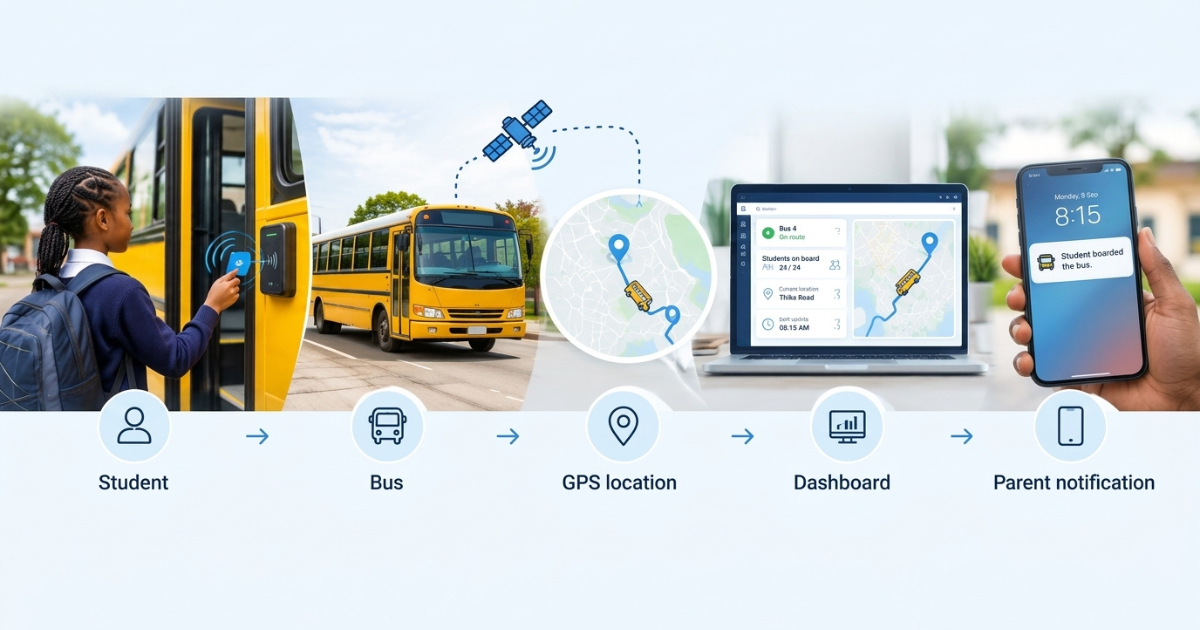
How NFC and telematics work together: a student’s boarding event and the bus’s GPS location combine into one connected journey record, from tap-in to parent notification.
Imagine a student boarding Bus 4 at a designated pickup point. Their NFC identifier is recorded at the moment of boarding, while the telematics system simultaneously provides the vehicle’s location. The platform links the two.
Instead of two separate facts, “Bus 4 was at Pickup Point A at 6:52 AM” and “Student X boarded at 6:52 AM”, the school gets one connected record: Student X boarded Bus 4 at Pickup Point A at 6:52 AM.
As the journey continues, telematics keeps providing vehicle-level information while the platform maintains the link to recorded student events. At school, a check-in adds another data point; at drop-off, a corresponding event helps complete the record. The result isn’t a pile of GPS coordinates and attendance logs; it’s a connected sequence of events describing the full journey.
Why This Matters in Kenya
Kenya’s school transport landscape spans established fleets on major corridors, contracted providers, and smaller arrangements that depend heavily on individual drivers and administrators. Traffic, route changes, roadworks, and weather can all affect a journey, and information available only after it has ended is increasingly inadequate. Transport managers need visibility while the journey is happening; parents, used to real-time communication elsewhere in daily life, expect the same for their child’s commute.
There’s also been a live regulatory conversation around school transport safety. In February 2026, the Traffic (School Transport) Rules were gazetted as Legal Notice No. 11 of 2026, requiring telematics systems for school transport vehicles. In July 2026, following cost and implementation concerns raised by groups including the Kenya Private Schools Association and the Kenya Motorists Association, the Senate annulled the rules. Those cost objections are real: telematics hardware, connectivity, and staff training are recurring expenses, and any credible integration strategy has to address who bears them, not just what the technology can do.
Although the mandate did not remain in force, the underlying challenges it sought to address haven’t gone away. Kenya continued to see school transport incidents through 2026, while NTSA continued issuing school bus safety guidance. Whether or not telematics becomes a formal requirement, the practical case for it – better visibility, faster response, clearer records – remains unchanged.
Regulation can accelerate or delay adoption, but it isn’t the reason to invest; what happens on the road every day is.
Technology should support safety procedures, not replace them. An NFC scan records a specific event. A GPS location records where a vehicle was. Neither, by itself, guarantees a child was safe; human supervision remains essential, particularly during boarding and alighting.
From Individual Features to Connected Data
The conversation usually starts with individual features: GPS tracking, NFC attendance, parent notifications, route management, and driver monitoring. The greater value appears once these stop operating as isolated tools and start forming one connected sequence: a scheduled pickup, a recorded boarding event, a journey tracked in motion, and a check-in at school. That shift changes what a school can actually do with the information.
Better transport coordination. Managers can work from a shared operational picture instead of collecting information from multiple people, checking a digital journey record instead of calling a driver, and capturing boarding information as it happens instead of waiting for a paper register.
More actionable transport data. Once journey and student events are recorded digitally, schools can look at patterns: which routes are consistently underused, which stops generate the most boarding activity, which vehicles carry the largest loads, how often journeys deviate from plan, and which routes see repeated delays. These questions move transport management from monitoring today’s trip toward understanding how the whole operation performs.
Stronger records for incident review. When an incident, missed pickup, or disputed journey occurs, a digital record, planned journey, vehicle assigned, student scheduled, boarding event, location, journey progression, drop-off, and relevant notifications give administrators a much stronger starting point than reconstructing events from memory. It doesn’t automatically determine what happened, but it’s real evidence to start from.
Better communication with parents. Parents don’t need raw telematics data; they need to know if the bus is approaching, whether their child boarded, and whether the journey is complete. Connected systems turn complex operational data into simple communication delivered at the moment parents need it, the real distinction between collecting data and making it useful.
What Schools Should Consider Before Integrating
Installing NFC readers and GPS devices doesn’t make the visibility problem disappear on its own. The technology is only part of the solution; schools also need to think through how it fits their existing operations.
Hardware. Bunifu Go, for example, offers hardware ranging from an NFC-enabled phone to custom devices; the right configuration depends on the school’s fleet, routes, infrastructure, and budget.
Staff adoption. Technology only works when the people running it actually use it: bus assistants need to understand the boarding process, gate staff need to understand check-in/out, and managers need to know how to read exceptions and reports. The goal is to make the digital process easier than the manual one, not add another burden.
Connectivity. Schools should ask practical questions about offline operation, data caching, synchronization, and what happens when connectivity drops.
Data protection. Student transport systems handle identifiable information, such as a student’s identity, schedule, attendance, and journey history, and need appropriate access controls, retention policies, and security. The relevant questions aren’t just “Can the system collect this?” but who can access it, why, for how long, and how it’s protected.
Cost and procurement. Integration has a real price attached: hardware per vehicle, per-student NFC identifiers, platform fees, connectivity, and staff time. The same cost pressure that led the Kenya Private Schools Association and Kenya Motorists Association to push back on the 2026 mandate applies here: schools should ask for a clear, itemized cost picture, one-time versus recurring, per-bus versus per-student, before adopting a solution, not just a features list.
Ultimately, the value of integration will depend on how effectively schools can use the technology within their day-to-day operations.
Where Bunifu Go Fits In
An integrated school transport platform isn’t about replacing one technology with another; it’s about bringing vehicle, student, and journey information into the same operational environment. Bunifu Go combines school transport management, attendance, and vehicle telematics with real-time vehicle tracking, route management, student boarding and drop-off records, parent notifications and reporting, including NFC-based attendance via keyfobs as one method of student identification.
For schools, that can mean fewer disconnected records and better visibility across the whole operation. For parents, it can mean useful information instead of a phone call to the school. For transport managers, it can mean less time reconstructing what happened and more time managing what’s happening.
The Bigger Shift: From Tracking Vehicles to Understanding Journeys
The most important development isn’t NFC, and it isn’t telematics; it’s the connection between the two kinds of data. GPS answers where the vehicle is. NFC can answer which student generated a transport event. Connecting them answers a more useful question: how does that student event relate to the vehicle’s journey? And once that information sits inside one operational platform, a school can start asking a bigger one: what should we do with it?
That’s where school transport technology stops being a tracking tool and becomes an operational system connecting vehicle-level telemetry with student-level events so a journey reads as one connected sequence of records, not scattered data points. For Kenya’s school transport sector, that shift could matter more than any single piece of hardware.
Knowing where the bus is has always been useful. Knowing what that location means for the students inside it is the next step.
Want to see how vehicle telematics and student-level records can work together for your school’s transport operation? Explore Bunifu Go.